
Massachusetts RMV Permit Practice Test 3
Test 3 of 10. Pick an answer for each question to see if it is right and why; your score appears at the end. You need 18 correct answers to pass, the same ratio as the real Massachusetts test.

- Questions25
- Correct to pass18
- Passing score72%
- Minimum age16 years
-
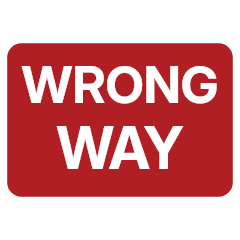
1. At a freeway exit ramp, this sign normally backs up which other regulatory sign posted nearer to the ramp terminal?
Show answer
Answer D: The sign that forbids entering that roadway at all
The two work as a pair at ramp terminals: one keeps drivers from turning in, and this one sits farther along to catch a driver who has already entered.
-
2. Unless signs indicate otherwise, what speed is treated as unreasonable in a Massachusetts thickly settled or business district?
Show answer
Answer D: More than 30 mph
Driving faster than 30 mph in a thickly settled or business district is not reasonable and proper unless posted signs set a 25 mph limit.
-
3. You are already inside an intersection when you realize you should be in the lane beside you. What should you do?
Show answer
Answer C: Stay in your lane through the intersection and change lanes afterwards
Drivers in an intersection are watching for cross traffic and turning vehicles, so an unexpected sideways move there is easily missed.
-
4. The vehicle you have borrowed is larger and heavier than your own. How should you drive it?
Show answer
Answer B: Allow more room for stopping and for turns until you are used to it
Extra weight and length mean longer stopping distances and wider turns, so give yourself more room until you are used to it.
-
5. What does compulsory Bodily Injury to Others coverage in Massachusetts not pay for?
Show answer
Answer D: Injuries to a passenger riding in your own car
Compulsory Bodily Injury to Others only covers crashes that happen in Massachusetts and never covers a passenger in the insured's own vehicle.
-
6. During the first six months with a Massachusetts Junior Operator License, which passenger under 18 may ride without a qualified adult in the front seat?
Show answer
Answer D: An immediate family member
For the first six months a Junior Operator may not carry anyone under 18 other than an immediate family member unless an adult at least 21 with one year of driving experience is seated beside the driver.
-
7. A Massachusetts applicant whose corrected vision in the better eye falls between 20/50 and 20/70 may be issued what?
Show answer
Answer C: A daylight only license
Corrected acuity between 20/50 and 20/70 in the better eye can qualify an applicant for a restricted license rather than a full one.
-
8. What is the suspension for a first conviction of violating the Massachusetts junior operator passenger or night restriction?
Show answer
Answer D: 60 days
A first offense brings a 60 day suspension, a second 180 days and any later offense a full year, on top of any other penalty imposed.
-
9. The vehicle you want to pass is traveling close to the speed limit. What should you do?
Show answer
Answer C: Stay behind, because a pass may not take you over the limit
The speed limit applies while passing too. If you cannot complete the pass without exceeding it, do not start the pass.
-
10. How large is the surcharge Massachusetts law adds to every speeding fine for the Head Injury Treatment Services Trust Fund?
Show answer
Answer C: 50 dollars
Every speeding fine carries a fixed surcharge that goes entirely to the Head Injury Treatment Services Trust Fund.
-
11. You turn left onto a road that has a center two-way left-turn lane. In which lane should you be traveling once the turn is finished?
Show answer
Answer D: The first through lane to the right of the center turn lane
The shared center lane is only for turning movements, so even where a state lets you pause in it to merge you must end up in the first ordinary travel lane beside it.
-
12. How closely may a Massachusetts driver follow an emergency vehicle that is responding to an alarm?
Show answer
Answer B: No closer than 300 feet
It is illegal to follow closer than 300 feet behind an emergency vehicle that is responding to an alarm.
-
13. What is the proper use of the horn?
Show answer
Answer C: To give a brief warning when another road user may not have seen you
The horn is a warning device meant to alert someone to your presence when a collision is possible, and using it in anger tends to escalate conflict rather than prevent crashes.
-
14. A United States numbered route is normally marked with
Show answer
Answer C: black numerals on a white shield
The U.S. route marker is a white shield carrying black numerals, which sets it apart at a glance from the red, white and blue Interstate shield.
-
15. A sign beside the signal reads STOP HERE ON RED. What does it tell you?
Show answer
Answer B: Stop at that point on red, not closer to the intersection
The sign marks the required stopping point, which is set back from the corner so that turning vehicles and sight lines are not blocked.
-
16. A Massachusetts crash caused by using a mobile electronic device leads to what?
Show answer
Answer A: Criminal charges and loss of the license
Injuring a person or damaging property through negligent driving is a crime, so a crash caused by device use brings charges and license loss.
-
17. Which facility does this sign direct a traveler toward?

Show answer
Answer B: A hospital offering emergency care
This is the standard marker for medical care, used to lead a traveler to a hospital where emergency treatment is available.
-
18. You are about to slow down sharply for a turn. Which check comes first?
Show answer
Answer A: A look in the mirror to see how close the traffic behind you is
Any hard slowing needs a mirror check first, because the driver behind is the one who has to react to it.
-
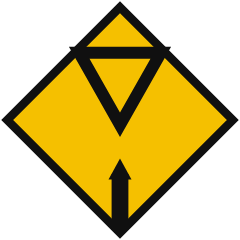
19. What will the driver have to do at the point this sign refers to?
Show answer
Answer C: Slow down and let conflicting traffic go first, stopping if that is what it takes
Further along, the driver has to let conflicting traffic and pedestrians go first, reducing speed and stopping whenever that is necessary to avoid interfering with them.
-
20. How long is the Massachusetts license suspension for a driver over 21 with no prior offense who refuses a chemical test?
Show answer
Answer C: 180 days
A first chemical test refusal by a driver over 21 with no prior operating under the influence offense carries a 180 day suspension.
-
21. In Massachusetts, three speeding violations within a 12 month period trigger which automatic action?
Show answer
Answer A: A 30 day license suspension
Three speeding violations inside a 12 month window, counted from the first citation, cause an automatic 30 day suspension.
-
22. How much clearance must a Massachusetts driver leave when passing a vulnerable road user such as a bicyclist?
Show answer
Answer C: At least four feet
State law requires a safe passing distance of at least four feet, and the driver may use the adjacent lane or cross the center line when it is safe to do so.
-
23. Which of these does NOT affect how fast alcohol reaches the bloodstream?
Show answer
Answer A: How confident the drinker feels
Food, the strength of the drinks and the speed of drinking all change how fast alcohol is absorbed, but a drinker's confidence changes nothing at all.
-
24. You park a manual transmission car facing uphill at a curb. What is the correct combination?
Show answer
Answer A: First gear, wheels turned away from the curb, parking brake set
Facing uphill the car would roll back, so first gear resists that, the wheels turned out let a tire catch the curb, and the parking brake holds it.
-
25. Under Massachusetts General Laws chapter 90 section 17C, what may a city or town adopt for its thickly settled roads?
Show answer
Answer C: A 25 mph limit signed at its borders
Section 17C lets a community adopt a lower thickly settled limit, and signs announcing it must be posted at all entrances to that city or town.