
Massachusetts RMV Permit Practice Test 2
Test 2 of 10. Pick an answer for each question to see if it is right and why; your score appears at the end. You need 18 correct answers to pass, the same ratio as the real Massachusetts test.

- Questions25
- Correct to pass18
- Passing score72%
- Minimum age16 years
-
1. What is the Massachusetts road test fee, charged even when an applicant fails the test or fails to appear?
Show answer
Answer D: 35 dollars
The RMV charges a flat 35 dollar road test fee covering application processing and scheduling, and it must be paid again before a new test is booked.
-
2. Who must accompany a Massachusetts Class D learner's permit holder while driving?
Show answer
Answer B: A licensed driver at least 21 who has driven for a year
The supervising driver must be at least 21, hold a valid license, have at least one year of driving experience and sit in the passenger seat beside the permit holder.
-
3. At an intersection where every approach carries this sign, two drivers arrive at exactly the same instant. Which of them goes first?

Show answer
Answer C: The driver on the right
Order of arrival decides who goes first, and when two vehicles arrive together the driver on the right proceeds while the other gives way.
-
4. What fine range does Massachusetts set for a first operating under the influence conviction?
Show answer
Answer B: 500 to 5,000 dollars
A first OUI conviction carries a fine of 500 to 5,000 dollars along with a possible prison term of up to two and a half years.
-
5. You are clear of the tracks after your vehicle stalled on a crossing. Whom should you contact?
Show answer
Answer C: The emergency number posted on the blue sign at the crossing, or 911
Grade crossings carry an emergency notification sign with a railroad phone number and a crossing identification number so that approaching trains can be stopped, and 911 works if that sign is not visible.
-
6. A yellow pennant-shaped sign is posted on the left side of a two-lane road facing you. What is it telling you?
Show answer
Answer B: You are entering a no-passing zone and may not start a pass
The pennant is placed on the left so that it faces the driver who might pull out, and it marks the beginning of a no-passing zone.
-
7. What filing fee must a Massachusetts driver pay the RMV to contest a civil motor vehicle citation?
Show answer
Answer C: 25 dollars
Requesting a hearing costs a 25 dollar filing fee, refunded only if the court finds the driver not responsible for every violation on the citation.
-
8. What must a Massachusetts applicant under 18 show about the six consecutive months immediately before the road test?
Show answer
Answer C: A clean record with no surchargeable events
An applicant under 18 must keep a clean driving record for the six consecutive months before applying, and any surchargeable incident restarts that period.
-
9. A center lane is bordered by a solid yellow line on the outside and a broken yellow line on the inside, with left-turn arrows painted in it. How may you use that lane?
Show answer
Answer A: Only to make a left turn or to prepare for one from either direction
That marking identifies a two-way left turn lane, which may only be used for left turns or to prepare for a left turn and never for travel or passing.
-
10. Besides a fine, what does a first mobile electronic device conviction cost a Massachusetts junior operator's license?
Show answer
Answer D: A 60 day suspension
A junior operator's first conviction for using a mobile electronic device brings a suspension along with a new permit exam, a retraining course and a new road test.
-
11. How many of the 25 questions on a Massachusetts learner's permit exam must be answered correctly to pass?
Show answer
Answer D: 18 questions
The RMV permit exam has 25 multiple choice questions and requires 18 correct answers inside the 25 minute time limit.
-
12. What is the fine for a first violation of the Massachusetts hands-free law?
Show answer
Answer A: 100 dollars
A first offense costs 100 dollars, a second costs 250 dollars plus a distracted driving program, and a third costs 500 dollars plus an insurance surcharge.
-
13. The green arrow protecting your turn changes to a steady yellow arrow. What is it telling you?
Show answer
Answer A: The protected turn is ending and you should prepare to stop
A steady yellow arrow warns that the arrow movement is being terminated and that a red indication will follow.
-
14. What fine does a first Massachusetts violation of the school bus stopping law carry?
Show answer
Answer C: 250 dollars
A first violation of the school bus stopping law can bring a license suspension along with a 250 dollar fine.
-
15. A Massachusetts Class D learner's permit holder under 18 may not drive between which hours unless a parent or legal guardian is in the vehicle?
Show answer
Answer A: Midnight and 5:00 a.m.
The permit curfew for drivers under 18 runs from midnight until 5:00 a.m., and only a parent or legal guardian riding along lifts it.
-
16. A driver's destination lies along the street to the right, and this sign stands at that corner. How should the driver reach it?
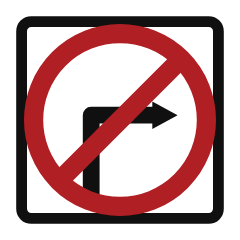
Show answer
Answer D: By going on and using a later intersection where turning is allowed
When a movement is barred at one corner the driver has to reroute, normally by continuing and coming back to the destination from a permitted approach.
-
17. A sign warns that your exit leaves from the left side of the freeway. What should you do?
Show answer
Answer D: Move into the left lane in good time before you reach the exit
Left-hand exits are unusual, which is exactly why they are signed well in advance and why the lane changes should be finished early.
-
18. A line of short dashes set closer together than an ordinary lane line runs beside your lane where a ramp leaves the highway. What does a dotted line of that kind convey?
Show answer
Answer A: A warning that the lane is about to change function
Dotted lines give guidance or warning about a downstream change, such as a lane that becomes an exit only lane or a lane line carried across an intersection.
-
19. You are approaching the entry of a roundabout and a pedestrian is crossing the marked crosswalk on your approach lane. What must you do?
Show answer
Answer D: Stop before the crosswalk and let the pedestrian cross
Roundabout crosswalks sit a short distance back from the yield line, and drivers must yield there before they ever reach the circulating lanes.
-
20. How long is the Massachusetts suspension for a chemical test refusal by a driver over 21 who has one prior operating under the influence offense?
Show answer
Answer D: Three years
A refusal with one prior operating under the influence offense costs a driver over 21 a three year suspension, and two priors bring five years.
-
21. How many Class D road test attempts does Massachusetts allow within a 12 month period?
Show answer
Answer A: Six
An applicant may not attempt more than six Class D road tests in any 12 month period.
-
22. Your vehicle does not have antilock brakes and you must stop quickly on a slippery road. What is the correct technique?
Show answer
Answer B: Apply the brakes firmly without locking the wheels, releasing slightly if they lock
Locked wheels slide and cannot steer. Squeezing the brakes to just short of lockup, and easing off if they lock, gives the shortest stop with control.
-
23. What is true about driving away from a crash you were involved in?
Show answer
Answer B: It is a serious offense, even if the other driver has driven away too
Leaving the scene is a criminal offense in every state, and the behavior of the other driver does not excuse it.
-
24. What is worth carrying in the vehicle during a winter trip?
Show answer
Answer A: A blanket, a flashlight, a scraper and a small shovel
A winter kit keeps you warm and visible if you are stopped for hours, and lets you clear glass and dig the wheels out. Hot water can crack cold glass.
-
25. A pedestrian with a white cane draws the cane back and steps away from the curb as you approach. What does that usually mean?
Show answer
Answer B: They are signaling you to go ahead and drive on
Pulling the cane in and stepping back from the curb is the customary way a blind pedestrian tells drivers to proceed.