
Massachusetts RMV Permit Practice Test 9
- Questions25
- Correct to pass18
- Passing score72%
- Minimum age16 years
-
1. A yellow diamond reading DIP warns a driver about
Show answer
Answer A: a short, sharp depression in the road surface
A dip is an abrupt low point that can jolt a vehicle or scrape its underside, so speed should be reduced before reaching it.
-
2. In the code that governs pavement markings, what does a double line stand for?
Show answer
Answer B: A maximum restriction
The marking code is consistent: a double line means the strongest restriction, a solid line discourages or forbids crossing, and a broken line is permissive.
-
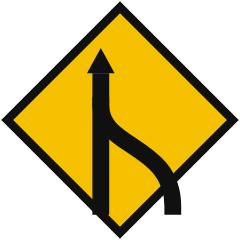
3. Why does the situation ahead of this sign deserve extra care from a motorcyclist?
Show answer
Answer C: Because a narrow machine is easy to overlook in a mirror or a blind spot
A motorcycle fills very little of a mirror and disappears easily into a blind spot, so the rider should adjust speed and lane position to stay visible where the streams come together.
-
4. A pedestrian signal displays a steady walking person symbol. What does it mean for a pedestrian at that corner?
Show answer
Answer B: The pedestrian may start crossing in the direction of the signal
The steady walking person permits a pedestrian to begin the crossing, while still yielding to vehicles already lawfully in the intersection.
-
5. The Massachusetts manual tells a driver who needs help from an officer at a roadside stop to do what?
Show answer
Answer C: Pull in front of the cruiser and ask for help
The manual tells drivers who need assistance to pull in front of the police cruiser rather than stopping behind it, and to wait beside their own vehicle if the officer is busy.
-
6. The lane you are in has a right-turn-only arrow painted on the pavement. What must you do?
Show answer
Answer C: Turn right, because a lane-use arrow is a legal requirement
Lane-use arrows painted on the pavement are regulatory markings, so a driver in that lane must travel in the direction shown.
-
7. Unpaid electronic toll violations from which states will block a Massachusetts license renewal?
Show answer
Answer B: Massachusetts, Maine and New Hampshire
Unpaid E-ZPass or Fast Lane toll violations from Massachusetts and two neighboring states stop the RMV from renewing a license.
-
8. When is it appropriate to use cruise control?
Show answer
Answer B: On a dry, open highway with light traffic
Cruise control suits steady conditions where you rarely need to change speed. It is a poor choice in traffic, on curves, on slippery roads or when drowsy, because it removes you from the speed decision.
-
9. Once you have parallel parked, how close to the curb should your wheels be?
Show answer
Answer C: Within the distance your state allows, commonly 12 to 18 inches
Parking close to and parallel with the curb keeps the vehicle out of the traffic lane without damaging the tires; each state sets the exact maximum, usually 12 inches and 18 inches in some states.
-
10. What is a good rule for any task you want to do inside the vehicle?
Show answer
Answer D: If it needs more than a moment, do it stopped
A glance of a second or two is manageable, but any task that runs longer belongs to a stopped vehicle, because the road does not pause while you do it.
-
11. The sign over the leftmost lane reads LEFT LANE MUST TURN LEFT. You are in that lane and want to go straight. What should you do?
Show answer
Answer C: Move out of the lane before the intersection if it is safe
A mandatory movement lane control sign makes the turn compulsory for that lane, so a driver who wants another movement must change lanes in advance.
-
12. On a Massachusetts highway with at least four lanes, two of them in the driver's direction, what does the move over law require near a stationary emergency vehicle?
Show answer
Answer A: Leaving an empty lane beside the scene
Where there are at least four lanes with two in the driver's direction, the driver must move to a lane that is not next to the one the emergency vehicle occupies.
-
13. A sign warns that the right lane ends ahead, and traffic is still flowing freely. What should you do if you are in that lane?
Show answer
Answer C: Signal, adjust your speed and move left in good time before the lane ends
When traffic is moving freely there is room to merge early and smoothly, which avoids the last-second lane change at the closure point.
-
14. How should you position your vehicle for a right turn from a two-way street?
Show answer
Answer B: As close as practical to the right curb or edge, then turn into the nearest right lane
Right turns are made from the lane nearest the right edge into the nearest available lane, which keeps the turn tight and prevents a wide sweep into other traffic.
-
15. You are stopped at a stop sign waiting to turn onto a highway where traffic moves at 55 mph. How should you choose your gap?
Show answer
Answer A: Wait for a much larger gap than the one you would accept on a city street
Fast traffic covers ground while you are still accelerating, so the gap that feels adequate at 25 mph is dangerously short at highway speed.
-
16. Which clue tells you that a parked vehicle is about to pull into traffic?
Show answer
Answer D: Exhaust smoke, brake lights, front wheels turned out or a driver in the seat
A running engine, lit brake lights, turned wheels or a person behind the wheel all mean the vehicle may move. Slow down and give it room.
-
17. Blue pavement markings are used together with white markings at
Show answer
Answer D: parking spaces reserved for people with disabilities
Blue supplements the white markings of accessible parking spaces, which is the only assignment blue has on the pavement.
-
18. Rain is falling and the outside temperature reads close to 32 degrees Fahrenheit. Why is that dangerous?
Show answer
Answer A: The rain can freeze on contact and glaze the road with ice
Near freezing, rain landing on cold pavement can turn to a glaze of ice almost at once, so a road that looks merely wet may have no grip at all.
-
19. At an intersection that uses a lagging left turn, when is the left-turn arrow displayed?
Show answer
Answer B: After the through movement has run
A lagging left turn phase runs at the end of the green rather than the start, so a driver waiting to turn should not assume the arrow has been missed.
-
20. A yellow diamond shows the two edges of the road pinching toward each other. What does it mean?
Show answer
Answer B: The pavement gets narrower but the lanes continue
The road narrows sign warns that the traveled way becomes tighter, leaving less room beside passing vehicles even though no lane is dropped.
-
21. Low sun is shining onto the signal ahead and you cannot tell which light is lit. What should you do?
Show answer
Answer D: Slow down and be ready to stop until you can be sure
An unreadable signal has to be treated as one that may be red, so approach slowly enough to stop while you work out what it shows.
-
22. How much driver's education instruction must a parent or guardian attend before a Massachusetts applicant under 18 can be licensed?
Show answer
Answer D: Two hours
A parent or guardian has to take part in a short block of the driver's education curriculum unless they already did so within the previous five years.
-
23. You have a green light and an ambulance with lights and siren enters the intersection against its red. What should you do?
Show answer
Answer B: Stop and let the ambulance go through
An emergency vehicle answering a call may cross against a red, and every other driver yields to it whatever their own signal shows.
-
24. A driver reaching a stop sign is required to do what?
Show answer
Answer D: Come to a complete stop and then proceed only when it is safe
A stop sign requires a full stop before the stop line, crosswalk or intersection, after which the driver may go on once the way is clear.
-
25. What is the recommended minimum distance between the driver's breastbone and the center of the steering wheel air bag cover?
Show answer
Answer C: About 10 inches
An air bag inflates extremely fast, and keeping that much space lets it deploy fully before it reaches the driver, which is why the seat should be moved back as far as still allows comfortable control of the pedals.