
Massachusetts RMV Permit Practice Test 4
- Questions25
- Correct to pass18
- Passing score72%
- Minimum age16 years
-
1. What is the highest license reinstatement fee the Massachusetts RMV charges for its most serious suspensions?
Show answer
Answer B: 1,200 dollars
Most reinstatement fees are 100 dollars, but fees for suspensions caused by the most serious offenses run considerably higher.
-
2. A notification appears on your smart watch while you are driving. What should you do?
Show answer
Answer B: Treat it as you would a phone and leave it
A watch screen demands the same eyes and the same attention as a phone, and a wrist is no safer a place to read a message than a dashboard.
-
3. A blue motorist service sign showing a fuel symbol and an arrow means that
Show answer
Answer D: fuel is available in the direction shown, and the sign imposes no obligation
Service signs are informational: they tell the driver what is available and in which direction, but they create no requirement.
-
4. How much clearance must a Massachusetts driver leave when passing a vulnerable road user such as a bicyclist?
Show answer
Answer C: At least four feet
State law requires a safe passing distance of at least four feet, and the driver may use the adjacent lane or cross the center line when it is safe to do so.
-
5. You realize your tires are running on ice. Which set of inputs is safest?
Show answer
Answer C: Gentle steering, no sudden braking, and no sudden acceleration
Whatever grip is left is used up at once by any sudden input, so every movement of wheel, brake and accelerator must be slow and small.
-
6. The tire pressure monitoring symbol lights up on your dashboard. What is the system telling you?
Show answer
Answer A: At least one tire is significantly underinflated
The system warns when a tire falls well below the recommended pressure. Check all four with a gauge and inflate to the placard figure while they are cold.
-
7. You are circulating in the inner lane of a two-lane roundabout, your exit is next, and a vehicle is beside you in the outer lane. What should you do?
Show answer
Answer C: Keep circulating around the island and take that same exit on your next time around
You may not cut across a vehicle in the outer lane; if you cannot exit safely, continue around the circle and try again.
-
8. What is true about driving away from a crash you were involved in?
Show answer
Answer B: It is a serious offense, even if the other driver has driven away too
Leaving the scene is a criminal offense in every state, and the behavior of the other driver does not excuse it.
-
9. When should you adjust your seat, mirrors and steering wheel?
Show answer
Answer B: Before you start moving
Adjusting the driving position while moving takes your attention and often your hands away from driving. Make every adjustment while parked, every time.
-
10. A traffic signal is dark and you reach the intersection at the same moment as a vehicle on your right. Who goes first?
Show answer
Answer A: The vehicle on your right, as at any all-way stop
A dark signal is treated as an all-way stop, and the usual tie-breaker then applies: the vehicle on the right goes first.
-
11. A yellow sign reading DEAD END is posted at the entrance to a street. What does it mean?
Show answer
Answer D: The street ends and there is no way through
A dead end street stops at its far end, so a driver who enters must come back out the same way.
-
12. Where is the safest place for children under 13 to ride?
Show answer
Answer C: In the back seat
The back seat keeps children away from the force of a deploying front air bag and is farther from the most common impact area, which is why it is recommended through at least age 12.
-
13. On a multi-lane street, a yield line is painted well back from an unsignalized crosswalk rather than right at it. Why?
Show answer
Answer D: So drivers in the other lanes can see the pedestrian
Setting the yield line back keeps a stopped vehicle from hiding a crossing pedestrian from drivers in the next lane, which is a common cause of these crashes.
-
14. Besides its height, what else matters about a head restraint?
Show answer
Answer C: That it is close to the back of the head, and not far behind it
A restraint that sits far behind the head lets the head snap back before it is caught, so a small gap is important.
-
15. The crossbuck, formed by two rectangular arms crossed in an X, is placed
Show answer
Answer D: on each highway approach to a railroad grade crossing
The crossbuck marks the location of a highway-rail grade crossing and is required on each highway approach to that crossing.
-
16. What is the safest way to deal with a vehicle sitting in your blind spot?
Show answer
Answer A: Slow a little or move ahead so that it is no longer beside you
You cannot control the other driver, but you can change your own speed so that the vehicle is no longer hidden beside you.
-
17. You are stopped at a T-intersection and a driver on the through road is signaling a right turn into your road. What is the safe assumption?
Show answer
Answer B: The driver may not actually turn, so wait until the vehicle slows and starts turning
A blinking signal may have been left on by mistake or may be for the next street, so wait until the vehicle actually slows and turns.
-
18. In plain words, what is understeer?
Show answer
Answer B: The vehicle keeps going straight even though the wheels are turned
Understeer means the front tires have run out of grip, so the vehicle takes a wider line than the one you steered.
-
19. In a work zone one lane sits an inch or two lower than the lane beside it. How should you change lanes?
Show answer
Answer C: Slow down and cross the edge at a shallow angle, holding the wheel firmly
A vertical edge between lanes can catch a tire and jerk the steering. Crossing slowly at a shallow angle lets the wheel climb without grabbing.
-
20. How much moving water is generally enough to float and carry away most passenger vehicles?
Show answer
Answer D: About one foot
About a foot of moving water will float most cars, and even less will stall an engine. That is why the rule is to turn around instead of judging the depth.
-
21. About how far ahead do low beam headlights let you see on a dark road?
Show answer
Answer B: About 250 feet
Low beams light roughly 250 feet of road, and high beams roughly 350 to 500 feet, which sets the limit on a safe night speed.
-
22. How does Massachusetts law describe a thickly settled district?
Show answer
Answer A: An area where buildings are fewer than 200 feet apart for a quarter mile or more
A thickly settled district is defined by building spacing: structures fewer than 200 feet apart along a quarter mile or more of road.
-
23. A driver sees this sign on a quiet road with no other traffic in either direction. What is the correct response?
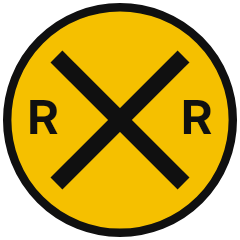
Show answer
Answer C: Slow down, look and listen for a train, and be ready to stop
The sign gives advance notice of a highway-rail grade crossing, so the driver reduces speed, checks both directions along the tracks and keeps enough room to stop short of the rails.
-
24. Why is this restriction so common beside fire hydrants, crosswalks and intersection corners?
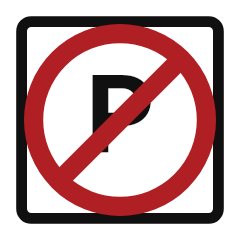
Show answer
Answer C: To keep sight lines open and leave access for emergency crews
A vehicle left in those places hides pedestrians from approaching drivers, blocks the path of turning vehicles and can keep firefighters from reaching a hydrant.
-
25. A sign with a green background and a white legend normally provides
Show answer
Answer A: directions, distances and destinations
Green is the background color of the guide sign series, which names routes and destinations and gives the distance to them.