
Massachusetts RMV Permit Practice Test 10
- Questions25
- Correct to pass18
- Passing score72%
- Minimum age16 years
-
1. A child seat was in the car during a moderate crash. What should be done with it?
Show answer
Answer A: Replace it, because a seat that has been through a crash may be weakened
Crash forces can damage a seat in ways you cannot see, so a seat involved in anything but the mildest crash is replaced.
-
2. You are about to pass another vehicle at night with your high beams on. What should you do?
Show answer
Answer C: Switch to low beams as you come up behind it and while you are alongside
High beams shining into the mirrors of the vehicle ahead blind the very driver whose reaction you depend on during the pass.
-
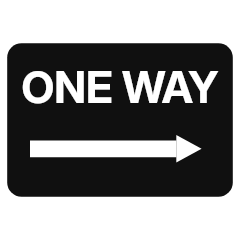
3. A driver on the street this sign governs is preparing to turn left at the next corner. Which lane should the vehicle be in beforehand?
Show answer
Answer A: The lane closest to the left curb
All the traffic here runs the same way, so nothing is coming toward the driver and the turn is taken from the extreme left lane rather than from beside the middle of the roadway.
-
4. You are waiting in a center two-way left-turn lane. What should you expect from oncoming traffic?
Show answer
Answer A: Oncoming drivers may enter the same lane to prepare their own left turns
Both directions share a two-way left-turn lane, so an oncoming vehicle may be waiting in it and you must never treat it as yours alone.
-
5. How often should the spare tire be checked?
Show answer
Answer C: Regularly, because a spare loses pressure while it sits unused
Spares lose air slowly over months, and a flat spare is useless at the moment you need it.
-
6. A driver who is passing you cannot complete the pass because a vehicle is coming. What should you do?
Show answer
Answer C: Ease off the accelerator and make room for them to drop back in
The only place for the passing vehicle to go is the gap behind you, and easing off opens that gap immediately.
-
7. It is cold and the road looks wet, but you notice the tires of vehicles ahead are throwing up no spray. What does this suggest?
Show answer
Answer B: The surface has frozen and is probably icy
Water throws spray, but ice does not. A shiny road with no spray in freezing temperatures is a strong sign of black ice, so slow down and avoid sudden inputs.
-
8. You are approaching a refuse collection truck working along your street. What should you expect?
Show answer
Answer D: Workers stepping into the road around the truck
Collection crews move constantly between the truck and the curb, often from where you cannot see them, so slow right down and pass only when the whole area is clear.
-
9. What is sensible when you drive in an unfamiliar town for the first time?
Show answer
Answer C: Drive a little slower and give yourself more time to read the signs
In unfamiliar surroundings you need longer to take in signs, junctions and markings, and lower speed buys that time.
-
10. A vehicle in front of you has already begun turning left into a driveway when the gap you were waiting for opens up. What should you do?
Show answer
Answer B: Wait and let that driver finish the turn
A vehicle that has lawfully started a maneuver keeps the right of way until it is finished.
-
11. From which lane should a permitted U-turn be started?
Show answer
Answer A: The lane nearest the center line, the same one used for a left turn
A U-turn is begun from the far left lane for your direction, the same position used for a left turn, so you do not cut across traffic beside you.
-
12. Where is a U-turn most clearly unsafe and generally prohibited?
Show answer
Answer D: On a curve or near a hill crest, where other drivers cannot see you
U-turns are barred where approaching drivers cannot see you in time, such as on a curve or near the top of a hill.
-
13. Your light turns green while a pedestrian who started on the walk signal is still crossing in front of you. What must you do?
Show answer
Answer D: Let them finish crossing the road before you move off on your green light
A pedestrian who entered the crosswalk lawfully keeps the right of way until they reach the other side, whatever the signal now shows.
-
14. Why should heavy objects in the passenger compartment be secured?
Show answer
Answer A: Because loose objects fly forward in a crash and can injure the people
Anything loose keeps traveling at the speed of the vehicle when the vehicle stops, so it strikes the occupants with great force.
-
15. You are joining a highway from a short ramp that has no acceleration lane. What should you do?
Show answer
Answer A: Stop or slow at the end of the ramp and wait for a safe gap
Without an acceleration lane there is no room to match speed, so you must yield at the end of the ramp and enter only when a gap allows it.
-
16. How may a two-way left-turn lane never be used?
Show answer
Answer B: As a through travel lane or a passing lane
The lane exists only for turning movements, so traveling or passing along it puts you head-on with vehicles turning from the opposite direction.
-
17. Beside an accessible parking space there is an area painted with diagonal stripes. What is it for?
Show answer
Answer C: It is an access aisle for wheelchairs and lifts, and no vehicle may park or stop in it
The striped access aisle gives the room a ramp or lift needs to deploy, so blocking it makes the adjacent accessible space unusable.
-
18. Small green signs with white numerals posted at regular intervals along a highway are used to
Show answer
Answer B: show distance along the route and give a reference point for reporting a location
Reference location signs, commonly called mileposts, carry white numerals on green and let a driver describe exactly where a breakdown or crash has occurred.
-
19. On dry pavement in good weather, what is the smallest following gap you should keep?
Show answer
Answer A: About three seconds behind the vehicle ahead
Three seconds is the accepted minimum on dry roads in good visibility, and the gap should be longer in poor conditions.
-
20. Your wiper blades smear the windshield instead of clearing it. What should you do?
Show answer
Answer C: Replace the blades, because smearing means that the rubber is worn
Worn or hardened rubber cannot wipe cleanly, and blades are cheap compared with driving without a clear view.
-
21. As a center two-way left-turn lane reaches an intersection, the markings change into a single left-turn lane. What does that mean for you?
Show answer
Answer D: From that point it serves one direction only, so use it just to turn left
Where the shared lane becomes a marked turn bay it belongs to one direction of travel, and only vehicles making that left turn may occupy it.
-
22. The center line beside your lane is a broken yellow line. What does it allow?
Show answer
Answer D: You may cross into the opposing lane to pass when it is safe and clear
A broken yellow center line marks a passing zone where traffic in that direction may cross into the opposing lane to pass when the way ahead is clear.
-
23. Is it acceptable to drive far below the flow of traffic on an open highway?
Show answer
Answer B: No, driving too slowly can obstruct traffic and create a hazard
Traffic that is much slower than the surrounding flow forces other drivers into sudden braking and unnecessary passing maneuvers, and impeding traffic is itself a violation.
-
24. Besides a fine, what does a first mobile electronic device conviction cost a Massachusetts junior operator's license?
Show answer
Answer D: A 60 day suspension
A junior operator's first conviction for using a mobile electronic device brings a suspension along with a new permit exam, a retraining course and a new road test.
-
25. The blue signs mounted before a freeway interchange that carry the logos of individual businesses are
Show answer
Answer C: specific service signs, which show the brands available at that exit
Specific service signs, often called logo signs, list eligible businesses for categories such as gas, food, lodging, camping, attractions and 24-hour pharmacies at the upcoming interchange.