
Massachusetts RMV Motorcycle Practice Test 6
Test 6 of 6. Pick an answer for each question to see if it is right and why; your score appears at the end. You need 18 correct answers to pass, the same ratio as the real Massachusetts test.
- Questions25
- Correct to pass18
- Passing score72%
- Minimum age16 years
-
1. A broken white line separates your lane from the lane on your right. What does it permit?
Show answer
Answer C: Changing lanes when it is safe to do so
A normal broken white line marks a boundary between lanes traveling the same way that road users may cross when it is safe.
-
2. Why is a wet road at night harder to read than the same road in daylight?
Show answer
Answer A: The wet surface reflects light away and swallows the lane markings
A film of water sends your headlight beam onward instead of back to you, so lines, edges and people in dark clothing almost disappear.
-
3. How long is the license suspension for a first Massachusetts operating under the influence conviction, before any alcohol education course is taken into account?
Show answer
Answer A: One year
A first OUI conviction suspends the license for a year, although an adult who completes a court approved alcohol education course may see it cut to 45 to 90 days.
-
4. How much following distance should you keep behind a motorcycle?
Show answer
Answer C: At least three to four seconds
A motorcycle can slow or stop very quickly and is easily upset by a surprise, so allow three to four seconds instead of the usual car gap.
-
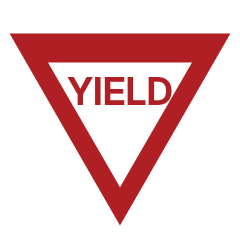
5. Apart from other vehicles, who else must a driver let go first at this sign?
Show answer
Answer A: Pedestrians and cyclists already in or entering the crossing
The duty to give way covers every road user who has the right of way at that point, including people walking or cycling across the driver's path.
-
6. Why are pedestrians and cyclists a special risk on unlit streets at night?
Show answer
Answer A: Dark clothing can make them invisible until they are very close
A person in dark clothing reflects almost no light and may not appear until they are inside your stopping distance, so cut your speed where people may be about.
-
7. You are riding alongside a car in the next lane at the same speed. What is the problem?
Show answer
Answer B: You may be sitting in the driver's blind spot with nowhere to escape
A driver who cannot see the motorcycle may change lanes into it, so riders adjust speed to move ahead of or behind the vehicle instead of staying beside it.
-
8. How large is the surcharge Massachusetts law adds to every speeding fine for the Head Injury Treatment Services Trust Fund?
Show answer
Answer C: 50 dollars
Every speeding fine carries a fixed surcharge that goes entirely to the Head Injury Treatment Services Trust Fund.
-
9. A crossing guard steps into the roadway ahead of this sign with one hand raised. What must the driver do?

Show answer
Answer B: Stop and stay stopped until the guard waves traffic on
An adult guard is controlling traffic at that crossing, so the instruction given by that person governs and the driver waits to be released.
-
10. Besides police cars, fire trucks and ambulances, which stopped vehicles does the Massachusetts move over law cover?
Show answer
Answer D: Maintenance and tow vehicles showing flashing lights
The law also covers highway maintenance vehicles and recovery vehicles such as tow trucks and ramp trucks when they display flashing emergency lights.
-
11. How far from a fire hydrant must a vehicle be parked in Massachusetts?
Show answer
Answer B: At least ten feet
Parking is prohibited within ten feet of a fire hydrant or a fire lane, and within twenty feet of an intersection.
-
12. A driver ahead of you extends the left arm straight out horizontally through the window. What is being signaled?
Show answer
Answer C: A left turn
The left arm held straight out is the standard hand signal for a left turn.
-
13. You reach an uncontrolled intersection at the same moment as a vehicle approaching from your left. What should you do?
Show answer
Answer A: Proceed, but only once you see that driver slowing
You have the right of way over the vehicle on your left, but a right of way is something the other driver has to give, so confirm it before you commit.
-
14. When must a Massachusetts driver stop for a school bus displaying flashing red lights and an extended stop sign?
Show answer
Answer C: No matter which side of the road the driver is on
Drivers must stop regardless of their direction of travel, and the only exception is a bus stopped on the other side of a divided highway with a barrier between the travel directions.
-
15. Which items belong to the Controls step of the T-CLOCS inspection?
Show answer
Answer D: Handlebars, levers, cables, hoses and the throttle
The Controls step covers everything the rider operates by hand or foot, plus the cables and hoses that carry those inputs to the machine.
-
16. On a Massachusetts highway with at least four lanes, two of them in the driver's direction, what does the move over law require near a stationary emergency vehicle?
Show answer
Answer A: Leaving an empty lane beside the scene
Where there are at least four lanes with two in the driver's direction, the driver must move to a lane that is not next to the one the emergency vehicle occupies.
-
17. How should a load be distributed between the two saddlebags?
Show answer
Answer B: Evenly, so the weight is balanced from side to side
An uneven load pulls the motorcycle toward the heavy side and makes it behave differently in left turns than in right turns.
-
18. A Massachusetts applicant whose corrected vision in the better eye falls between 20/50 and 20/70 may be issued what?
Show answer
Answer C: A daylight only license
Corrected acuity between 20/50 and 20/70 in the better eye can qualify an applicant for a restricted license rather than a full one.
-
19. The oil pressure warning light comes on while you are riding. What should you do?
Show answer
Answer D: Stop as soon as it is safe and shut the engine off
That light warns that the engine may not be receiving oil, and every extra minute of running risks destroying it.
-
20. Which clothing color is most likely to get a rider noticed in daylight?
Show answer
Answer B: Bright orange, yellow or green, which contrast with backgrounds
High visibility colors stand out against road, foliage and vehicles, which helps drivers pick a motorcycle out of a busy background during the day.
-
21. What fee does the Massachusetts RMV charge for the learner's permit exam?
Show answer
Answer B: 30 dollars
The learner's permit exam fee is 30 dollars and it is charged again whenever the applicant fails the exam or lets the permit expire.
-
22. How long is a standard Massachusetts driver's license valid?
Show answer
Answer C: Five years
A Massachusetts driver's license runs for a maximum of five years and normally expires on the holder's birthday.
-
23. A yellow diamond showing arrows arranged in a circle warns of
Show answer
Answer B: a circular intersection such as a roundabout ahead
The circular intersection warning sign announces a roundabout or traffic circle so drivers can slow down and prepare to yield to traffic already circulating.
-
24. What fine does a Massachusetts open container conviction carry for a driver over 21?
Show answer
Answer C: 100 to 500 dollars
Having an open alcoholic drink inside the vehicle, even in a passenger's hands, brings a fine within a set band for a driver over 21.
-
25. A parking space is marked with the international symbol of access. Who may use it?
Show answer
Answer A: Only a vehicle displaying the required placard or plate
Accessible spaces may be used only by a vehicle that displays a valid disability placard or plate, no matter how short the stop would be.