
Massachusetts RMV Motorcycle Practice Test 31
- Questions25
- Correct to pass18
- Passing score72%
- Minimum age16 years
-
1. Where should you be looking as you steer through a turn?
Show answer
Answer C: Toward the point on the new road where you want to end up
Drivers steer toward what they look at, so looking through the turn to where you want to go keeps the path smooth and accurate.
-
2. You are leaving a freeway on an exit ramp posted with an advisory speed of 25 mph. Where should you slow to that speed?
Show answer
Answer A: In the deceleration lane, before you reach the curve of the ramp
Slowing belongs in the deceleration lane so you arrive at the curve already at the advisory speed and do not hold up traffic still in the through lanes.
-
3. When is a rider ready to start carrying passengers?
Show answer
Answer B: After enough solo experience to handle the machine without thinking
A passenger changes how the machine accelerates, brakes and turns, and only a rider who no longer has to think about the basics has attention to spare for that.
-
4. Rain has been falling steadily for half an hour. How does traction compare with the first minutes of the shower?
Show answer
Answer C: It usually improves somewhat, because the early oil film has washed away
Rain floats oil and dust to the top at first, so the road is most slippery in the early minutes, and a longer downpour rinses much of that film away. The pavement is still wet and grips less than when it is dry.
-
5. How should a group plan its rest stops on a long day?
Show answer
Answer A: Around the rider who tires first, with breaks before anyone is worn out
Fatigue destroys judgment long before a rider admits to it, so the break schedule follows the least rested rider rather than the strongest one.
-
6. The crossing gates begin to lower while your vehicle is still on the railroad tracks. What should you do?
Show answer
Answer B: Keep going forward and push through the gate if it should block your way
Gates are made to break away, and driving forward off the tracks is far safer than staying between them or backing up.
-
7. You are inside a tunnel with no shoulder when an ambulance comes up behind you with lights and siren. What should you do?
Show answer
Answer D: Keep going at a safe speed and pull over once you are clear of the tunnel
Stopping in a tunnel or on a narrow bridge blocks the only lane, so continue at a safe speed to the first place where you can pull clear.
-
8. Which items belong to the Controls step of the T-CLOCS inspection?
Show answer
Answer D: Handlebars, levers, cables, hoses and the throttle
The Controls step covers everything the rider operates by hand or foot, plus the cables and hoses that carry those inputs to the machine.
-
9. How should the brake light be checked before a ride?
Show answer
Answer D: Confirm that the hand lever and the foot pedal each switch it on
Many motorcycles use a separate switch for each brake control, so both the lever and the pedal have to be tested one at a time.
-
10. A sign on a freeway restricts trucks to the two right-hand lanes. What should a car driver expect in those lanes?
Show answer
Answer A: More heavy vehicles and slower changes of speed
A truck lane restriction concentrates heavy vehicles on the right, and those vehicles accelerate, brake and change lanes far more slowly than cars.
-
11. What does the Lights and Electrics step of T-CLOCS include?
Show answer
Answer A: The battery, the headlight, the brake light and the wiring
This step covers the battery and its terminals, the headlight, tail and brake lights, the turn signals, the switches, the mirrors and the wiring.
-
12. Loose gravel has been swept into the middle of your lane on a downhill bend. Which controls are affected most?
Show answer
Answer D: Steering and braking, since the loose stones roll under the tires
Gravel rolls between rubber and pavement, so the tires can neither turn the vehicle nor slow it as they would on a clean surface.
-
13. Which of these does NOT affect how fast alcohol reaches the bloodstream?
Show answer
Answer A: How confident the drinker feels
Food, the strength of the drinks and the speed of drinking all change how fast alcohol is absorbed, but a drinker's confidence changes nothing at all.
-
14. Two vehicles reach a four-way stop at the same moment from adjacent roads. Who should go first?
Show answer
Answer A: The driver on the right
When two drivers stop at a four-way stop at the same time, the driver on the left yields to the driver on the right.
-
15. You are about to pass a long tractor-trailer on a two-lane road. What should you expect?
Show answer
Answer B: You will need more clear road, since the vehicle is much longer
A tractor-trailer can be 70 feet long, so passing it takes more distance and more time than passing a car at the same speed difference.
-
16. A signal on an entrance ramp changes from red to green and lets one vehicle at a time onto the highway. What should you do?
Show answer
Answer A: Stop on the red and go on the green, one vehicle for each green
A ramp meter spaces vehicles out so they join the highway one at a time instead of arriving as a group, and it is a traffic signal like any other.
-
17. A regulatory sign reads TURN ON HEADLIGHTS NEXT 15 MILES. What does it require?
Show answer
Answer C: Low beam headlights on for that stretch, day or night
Such a section is signed where a road is hard to see along, and the requirement is to run headlights, not just daytime running lamps, through the whole stretch even in bright daylight.
-
18. How should a riding jacket fit?
Show answer
Answer B: Snug at the neck, wrists and waist so that it cannot balloon open
A jacket closed at the openings stays in place in a fall and does not flap in the wind, which is both tiring and distracting.
-
19. You have stopped on the shoulder of a highway and want to rejoin the traffic. What is the correct way?
Show answer
Answer D: Signal, build up speed along the shoulder, then merge into a gap
Entering a fast lane at a slow speed is what causes the conflict, so the shoulder is used to gain speed before the merge in the same way as an acceleration lane.
-
20. What happens to your field of vision as your speed increases?
Show answer
Answer C: It narrows, so you notice less at the sides of the road
The faster you travel, the more your useful field of view narrows toward the center, so a hazard coming from the side is seen late or missed altogether.
-
21. A yellow sign reading DEAD END is posted at the entrance to a street. What does it mean?
Show answer
Answer D: The street ends and there is no way through
A dead end street stops at its far end, so a driver who enters must come back out the same way.
-
22. How should a passenger swing their leg when getting off the motorcycle?
Show answer
Answer D: High and clear of the exhaust and the rear of the machine
A leg dragged low across the back of the motorcycle can catch the seat or the luggage and will find the hot exhaust, so it is lifted well clear.
-
23. You are the second vehicle waiting to turn left on a green ball. Where should you wait?
Show answer
Answer A: Behind the stop line, until the first vehicle has actually turned
Only the lead vehicle should move into the intersection to wait; a second vehicle inside it is likely to be stranded there when the light changes.
-
24. Why is a sign reading BRIDGE ICES BEFORE ROAD worth heeding even when the road itself is merely wet?
Show answer
Answer C: Cold air passes under a bridge as well as over it
A bridge deck loses heat from below as well as above, so it can be frozen while the road on either side of it is only wet.
-
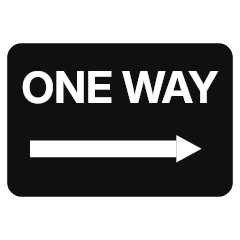
25. A driver disregards this sign and turns so as to travel against the direction it establishes. What is the immediate danger?
Show answer
Answer D: The driver will face traffic head on, because every lane comes the other way
Turning against the established direction puts the vehicle nose to nose with all the traffic on that street, which is why the mistake has to be corrected at once.