
Massachusetts RMV Motorcycle Practice Test 21
- Questions25
- Correct to pass18
- Passing score72%
- Minimum age16 years
-
1. You feel fine twenty minutes after your last drink. Why is that a poor guide to driving?
Show answer
Answer B: Your blood alcohol level can still be rising
Alcohol keeps being absorbed for some time after the last drink, so a driver who feels able at the door can be more impaired a few miles down the road.
-
2. You reach a T intersection where the cross street has a ONE WAY sign pointing to the right. What may you do?
Show answer
Answer B: Turn right only, because the street carries traffic in that direction
The arrow shows the only direction traffic may travel, so the only legal movement from the terminating road is a right turn.
-
3. A school sign paired with a plaque showing a diagonal downward-pointing arrow is installed
Show answer
Answer D: at the school crossing itself, or as close to it as possible
The diagonal downward arrow points at the crossing, so this assembly is placed at the crossing location rather than in advance of it.
-
4. You are turning onto a street that has two lanes going your way. Which lane should you enter?
Show answer
Answer B: The lane closest to you, changing lanes later if you need to
Turn into the nearest lane going your direction and make any lane change afterwards, when you have signaled and checked that it is clear.
-
5. How should a long trip be broken up to keep the driver alert?
Show answer
Answer D: Stop for a break every couple of hours and share out the driving
Regular breaks and a change of driver are the only reliable answers to fatigue; caffeine only postpones it.
-
6. A city transit bus at a stop ahead of you switches on its left signal. What should you do?
Show answer
Answer D: Slow and let the bus pull back into traffic
A bus needs a long gap to rejoin traffic, and yielding to a signaling transit bus keeps the whole line of traffic moving safely.
-
7. You have stopped after a crash. Why should the engines of the vehicles involved be switched off?
Show answer
Answer A: To reduce the risk of a fire starting around any fuel that has spilled
Crashes often break fuel lines, and a running engine is a source of ignition, so switching off lowers the risk of fire.
-
8. Your passenger has ridden on other people's motorcycles before. What should you do before setting off?
Show answer
Answer A: Brief them anyway, because your machine and your instructions differ
Handholds, footrests, exhaust position and the signals a rider uses all vary from machine to machine, so every passenger is briefed on the machine they are about to ride on.
-
9. You are turning right off a street into a parking lot driveway that crosses a bike lane and a sidewalk. Who has the right of way?
Show answer
Answer D: Pedestrians on the sidewalk and riders in the bike lane
Turning into a driveway means crossing the paths of people who were already traveling straight, so you give way to both the bike lane and the sidewalk.
-
10. You are traveling beside a solid white lane line. What does it tell you?
Show answer
Answer B: Crossing it is discouraged or prohibited, so stay in your lane
A solid white line separates lanes going the same direction where lane changing is discouraged or prohibited, such as where a through lane meets a mandatory turn lane.
-
11. An ambulance with lights and siren is coming toward you on an undivided two-lane road. What must you do?
Show answer
Answer A: Pull to the right edge and stop until it passes
On an undivided road, drivers in both directions clear the way, pulling to the right edge and stopping.
-
12. You and an opposing driver reach a four-way stop at the same time and both of you are turning right. What should happen?
Show answer
Answer C: Both may turn at the same time into their own lanes
Two opposing right turns take drivers into different lanes without crossing, so both can proceed together once pedestrians are clear.
-
13. Children are playing close to the edge of a residential street. What is the right speed choice?
Show answer
Answer D: Well below the limit, slow enough to stop for a sudden dash
Children can step out without warning, so the safe speed is the one that lets you stop within the distance you can see to be clear.
-
14. Federal law lets a state open its high-occupancy vehicle lanes to certain vehicles carrying only one person. Which of these is covered by that allowance?
Show answer
Answer B: Motorcycles
Federal law lets states allow motorcycles into high-occupancy vehicle lanes regardless of the number of occupants, because keeping riders in the flow is safer than the alternative.
-
15. What does a tire with worn tread do on a wet road?
Show answer
Answer B: It loses grip and it hydroplanes at a lower speed than a good tire
Tread grooves carry water away from the contact patch, and a worn tire cannot do that, so it floats on the water sooner.
-
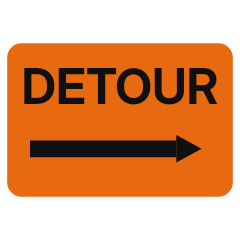
16. Which of these is true of the roadway a driver is being sent onto here?
Show answer
Answer D: Its own signs, signals and speed limits govern for the whole way around
The alternate route is an ordinary public road, so every control posted on it governs as usual; being sent that way grants no extra priority and no relief from the limits in force there.
-
17. How does riding in a formation change your responsibility for your own space cushion?
Show answer
Answer C: It does not change it, because each rider still manages their own space and decisions
A formation organizes the group, but every rider remains responsible for their own following distance, escape paths and riding decisions.
-
18. You are in the middle lane of a one-way street with three lanes when a police car approaches from behind with lights and siren. What should you do?
Show answer
Answer C: Pull to the nearest curb and stop clear of the lanes
On a one-way street you clear to whichever curb is closest, so the emergency vehicle gets a clear path down the open lanes.
-
19. You are approaching a narrow bridge where the road has one lane in each direction and no shoulder. What should you do about passing?
Show answer
Answer B: Do not pass on or near the bridge
A narrow bridge gives neither vehicle anywhere to go, so passing is prohibited there in the same way as on a hill or in a tunnel.
-
20. A rider in the middle of the group pulls over onto the shoulder. What should the sweep rider do?
Show answer
Answer C: Stop and stay with that rider while the rest of the group continues
The sweep exists so that no rider is ever left alone at the roadside, while the remainder of the group carries on to a safe place to wait.
-
21. What is the main function of the guide sign series?
Show answer
Answer D: To identify routes and lead road users to their destinations
Guide signs identify routes, name destinations and give distances, so drivers can navigate without stopping to consult a map.
-
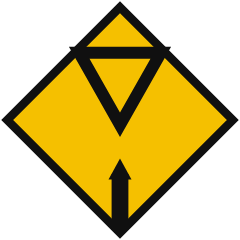
22. What will the driver have to do at the point this sign refers to?
Show answer
Answer C: Slow down and let conflicting traffic go first, stopping if that is what it takes
Further along, the driver has to let conflicting traffic and pedestrians go first, reducing speed and stopping whenever that is necessary to avoid interfering with them.
-
23. The rider behind you is closing right up on your machine and crowding you. What is the best response?
Show answer
Answer D: Let them go past and take a position behind them instead
Speeding up to escape a rider who is following too closely usually brings them with you, while letting them past removes the pressure entirely.
-
24. What is the usual result of driving well above the flow of traffic on a typical trip?
Show answer
Answer B: Very little time saved, with much greater risk
Signals, traffic and short distances swallow the theoretical gain, while crash risk and crash severity both climb sharply with speed.
-
25. You have turned onto a ramp at night and your headlights pick out large white arrows painted on the pavement pointing straight back at you. What do they mean?
Show answer
Answer C: You are traveling against the flow and must turn back
Wrong-way arrows are laid so that a driver going the correct way never sees them head on, so an arrow pointing at you means you are on the ramp backwards.