
Massachusetts RMV Permit Practice Test 46
- Questions25
- Correct to pass18
- Passing score72%
- Minimum age16 years
-
1. You have stopped on the shoulder of a busy freeway with a flat tire that you cannot change safely. Where should you and your passengers wait?
Show answer
Answer A: Well away from the traffic side, behind a barrier or up the bank if there is one
People struck on the shoulder are a common cause of roadside deaths, so wait away from the traffic side and behind any barrier.
-
2. Another driver has pulled out to pass you. What should you do?
Show answer
Answer A: Stay in your lane, keep your speed steady or ease off, and let the pass finish
Accelerating while being passed forces the other driver to stay in the opposing lane longer, so the safe response is to hold or slightly reduce speed and stay right.
-
3. Your green left-turn arrow goes out and a steady green ball stays lit. What may you do?
Show answer
Answer A: Continue turning left, but only after yielding to oncoming traffic
When the arrow ends and a green ball remains, the turn changes from protected to permissive, so it is still allowed but oncoming traffic goes first.
-
4. You are about to drive a rental car that you have never driven before. What should you do?
Show answer
Answer A: Adjust the seat and the mirrors and find the controls before moving off
Hunting for the wipers or the lights in traffic is a distraction, so learn the layout while the vehicle is stopped.
-
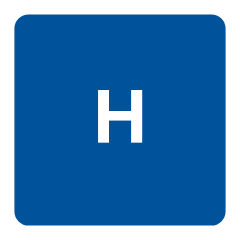
5. Which of these is announced with the same family of signs as the facility shown here?
Show answer
Answer A: A rest area for travelers
A rest area belongs to the same motorist service series, which points travelers toward facilities such as fuel, food, lodging and medical care.
-
6. You want to turn right at a steady red light and no sign prohibits the turn. What is required?
Show answer
Answer B: Come to a complete stop, then yield to traffic and pedestrians before turning
A right turn on a steady red is permitted only after a complete stop and only after yielding to cross traffic and to pedestrians, and a posted sign can prohibit it entirely.
-
7. May you park across the entrance to a fire station?
Show answer
Answer D: No, an emergency exit must never be blocked
Emergency vehicles must be able to leave the moment a call comes in, so their entrances and exits are kept clear at all hours.
-
8. A barricade carries a sign reading ROAD CLOSED TO THROUGH TRAFFIC. What does it permit?
Show answer
Answer B: Local access for people whose destination is on that road
This closure keeps out drivers who are only passing through while still allowing residents and deliveries to reach addresses within the closed section.
-
9. Where do you find how much weight your vehicle may carry?
Show answer
Answer C: On the placard in the driver door opening
The certification placard in the driver door opening gives the load limit and the recommended cold tire pressures for the vehicle as built.
-
10. Do hazard lights make it legal to leave your vehicle in a no parking zone?
Show answer
Answer A: No, they warn other drivers but do not permit the parking
Hazard lights are a warning device, not a permit; the parking restriction applies whether they are flashing or not.
-
11. May you park in front of a public or private driveway?
Show answer
Answer A: No, blocking a driveway is prohibited even for a short time
Parking in front of a driveway blocks the property owner from entering or leaving, and the prohibition does not depend on how long you stay.
-
12. Why is hard braking the wrong response to a tire blowout at speed?
Show answer
Answer C: Because it can pull the vehicle further out of line and start it spinning
With one tire gone the braking forces are uneven, so heavy braking increases the pull to one side and can spin the vehicle.
-
13. Your vehicle has broken down at night on a rural road and your phone has no signal. What is the safest thing to do?
Show answer
Answer C: Stay with the vehicle, keep the hazard lights on and wait for help
A lit vehicle is far easier to find than a person walking in the dark, and running the engine while you sleep risks carbon monoxide.
-
14. A large panel mounted on a trailer at the roadside displays a flashing arrow pointing left. What does it tell you?
Show answer
Answer B: Move into the lane to your left
An arrow panel directs traffic out of a closed lane, so the arrow shows the direction you must move rather than the shape of the road ahead.
-
15. A sign on a divided highway reads Keep Right Except to Pass. What does it require of you?
Show answer
Answer A: Use the left lane only to overtake, then return to a lane on the right
The left lane on such a highway is reserved for overtaking, so a driver who has finished a pass must move back to the right.
-
16. How should a head restraint be adjusted?
Show answer
Answer D: So the top is at least as high as the back of your head and close behind it
A restraint set at head height and close behind limits how far the head snaps backward in a rear impact, which is what reduces neck injury.
-
17. You have just returned to your own lane after passing. Why should you not slow down straight away?
Show answer
Answer A: The vehicle you passed is close behind and needs room to stop
Returning and then braking leaves the driver you just overtook with almost no following distance, which is how a pass turns into a rear-end collision.
-
18. The red oil pressure warning light comes on while you are driving. What should you do?
Show answer
Answer C: Pull over safely as soon as possible and shut off the engine
Loss of oil pressure means the engine is no longer being lubricated and can be destroyed within minutes. Stop, shut down and check before restarting.
-
19. A deer crosses the road in front of you and disappears into the trees. What should you expect?
Show answer
Answer B: That other deer are likely to follow it across the very same stretch of road
Deer usually move in groups, so one crossing the road is a warning that more may follow.
-
20. Three surchargeable events within a two year period require a Massachusetts driver to do what?
Show answer
Answer D: Complete the Driver Retraining Course within 90 days
The RMV orders the Massachusetts Driver Retraining Course, and the license is suspended until the course is finished if it is not completed within 90 days.
-
21. Reaching for a drink in the cup holder is which kind of distraction?
Show answer
Answer A: Manual and visual at the same time
Your hand leaves the wheel and your eyes flick down to find the cup, so a task that feels trivial takes away two of the three things driving needs.
-
22. You are driving on a road covered with a layer of wet fallen leaves. What should you expect?
Show answer
Answer B: As little grip as on ice, plus hidden markings and hidden holes
Wet leaves are as slippery as ice and they hide the lane lines and any potholes underneath, so slow well before curves and stops.
-
23. In a work zone, the flagger's instructions conflict with the pavement markings still visible on the road. Which do you follow?
Show answer
Answer B: The flagger, because a person directing traffic outranks the markings
An authorized flagger controlling a temporary traffic control zone overrides signs, signals and markings, and drivers must obey the flagger's signals.
-
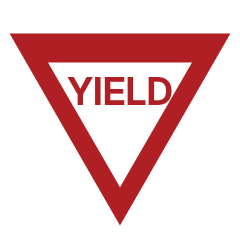
24. A driver passes this sign on an entrance ramp while merging onto a freeway. Who has priority?
Show answer
Answer B: The traffic already traveling on the freeway
The sign places the duty on the entering driver, who must adjust speed and fit into a gap without forcing through traffic to brake or swerve.
-
25. You notice a bulge on the sidewall of one of your tires. What should you do?
Show answer
Answer D: Have the tire replaced before driving far, because it could blow out
A sidewall bulge means the internal cords have broken and only the rubber is holding the air. The tire can fail suddenly at any speed.