
Massachusetts RMV Permit Practice Test 43
- Questions25
- Correct to pass18
- Passing score72%
- Minimum age16 years
-
1. Which statement about standard drinks is correct?
Show answer
Answer C: A standard serving of beer, of table wine and of distilled spirits each contain about the same amount of pure alcohol
Roughly 12 ounces of regular beer, 5 ounces of table wine and 1.5 ounces of 80 proof spirits each contain about the same amount of pure alcohol, so the type of drink does not change the effect.
-
2. The street you are turning right onto has a bike lane along its right edge. Where should your vehicle end up?
Show answer
Answer B: In the first traffic lane to the left of the bike lane
A bike lane is not a travel lane for motor vehicles, so the nearest lane you may finish a right turn in is the first general traffic lane beside it.
-
3. The driver of a slow farm vehicle moves partly onto the shoulder and waves you past. Who is responsible for the pass?
Show answer
Answer A: You are, so pass only if you can see that the road is clear
A courtesy wave is not a traffic control, and the driver who changes lanes is the one answerable for the maneuver.
-
4. On a rural two-lane road you pass small blue signs, each naming one business with an arrow and a distance. What are they?
Show answer
Answer D: Tourist-oriented directional signs for traveler businesses
Tourist-oriented directional signs carry a white legend on blue and are used on rural conventional roads to guide travelers to eligible businesses.
-
5. A Massachusetts driver under 18 who fails a chemical test faces a 30 day suspension plus what additional period?
Show answer
Answer D: One year
Chapter 90 section 24P adds a further period for a driver under 18, and entry into a Department of Public Health approved alcohol education program can reduce it to 180 days.
-
6. During the reversing part of a three-point turn, where should you be looking?
Show answer
Answer C: Over your shoulder through the rear window, glancing both ways
You look through the rear window in the direction the car is moving, checking both ways for traffic and people, because mirrors and cameras leave blind areas.
-
7. Unless signs indicate otherwise, what speed is treated as unreasonable in a Massachusetts thickly settled or business district?
Show answer
Answer D: More than 30 mph
Driving faster than 30 mph in a thickly settled or business district is not reasonable and proper unless posted signs set a 25 mph limit.
-
8. You are driving in fog so thick that you can barely see the vehicle ahead. Which pavement marking is the best guide for staying in your lane?
Show answer
Answer A: The white edge line on the right side of the road
The right edge line keeps you positioned away from oncoming traffic and is easy to follow at low speed. Following tail lights closely tempts you to drive faster than you can see.
-
9. A large truck ahead of you in a roundabout is using part of both lanes as it goes around. What is the correct response?
Show answer
Answer B: Stay back and give it room until it leaves the roundabout
Long vehicles need extra width to get around the central island, so drivers behind must hold back rather than share the space beside them.
-
10. Traffic is backed up beyond a railroad crossing. When may you start across the tracks?
Show answer
Answer B: Only when there is room for your whole vehicle on the far side
Never enter a crossing you cannot clear; a vehicle stopped on the tracks in a queue has nowhere to go if the signals start.
-
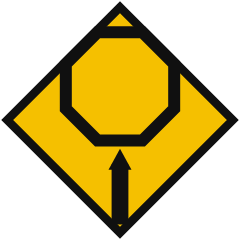
11. On a wet road, how should a driver adjust after passing this sign?
Show answer
Answer B: Start braking earlier, because a slippery surface lengthens the stopping distance
A wet surface lengthens stopping distance, so the extra warning distance should be spent braking gently and early instead of late and hard.
-
12. Where should you be looking as you steer through a turn?
Show answer
Answer C: Toward the point on the new road where you want to end up
Drivers steer toward what they look at, so looking through the turn to where you want to go keeps the path smooth and accurate.
-
13. At an intersection where every approach carries this sign, two drivers arrive at exactly the same instant. Which of them goes first?

Show answer
Answer C: The driver on the right
Order of arrival decides who goes first, and when two vehicles arrive together the driver on the right proceeds while the other gives way.
-
14. You enter a work zone at night where one lane is closed and a flagger is on duty. What is the safest approach?
Show answer
Answer A: Slow early, merge before the closure and be ready to stop
Merging early at a reduced speed keeps the queue orderly and leaves you room to stop for equipment, workers or traffic that has halted ahead.
-
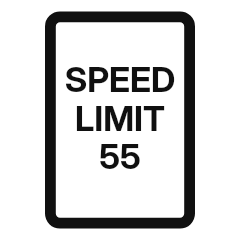
15. Heavy rain has left standing water on the road where this sign is posted. What does the law expect of the driver?
Show answer
Answer C: Driving below the posted figure, at a speed that suits the conditions
Drivers must adapt to conditions, so in rain, fog, snow or dense traffic the safe speed falls below the posted maximum and keeping to that maximum can itself be an offense.
-
16. You have stopped at a stop line but parked cars hide the cross street. What comes next?
Show answer
Answer C: Edge forward to where you can see, stopping again if needed
The legal stop at the line is only the first stop; you then move up slowly to a point where you can see, and stop again if traffic requires it.
-
17. You want to pass on a two-lane road where several people are walking on the narrow shoulder ahead. What should you consider?
Show answer
Answer D: There is no escape room if the pass goes wrong, so wait for a better place
A pass depends on having somewhere to go if it goes wrong, and a shoulder occupied by pedestrians removes that option for both vehicles.
-
18. You and an opposing driver reach a four-way stop at the same time and both of you are turning right. What should happen?
Show answer
Answer C: Both may turn at the same time into their own lanes
Two opposing right turns take drivers into different lanes without crossing, so both can proceed together once pedestrians are clear.
-
19. A driver on a hands free call looks straight at a red light and drives through it. What best explains this?
Show answer
Answer B: The eyes saw it but the brain did not process it
Attention, not eyesight, decides what a driver actually sees, and a loaded mind can leave a driver looking straight at a hazard without registering it.
-
20. You are traveling beside a tractor-trailer and cannot see the truck driver's face in any of the truck's mirrors. What does that tell you?
Show answer
Answer A: The truck driver probably cannot see your vehicle
Large trucks have deep blind spots on all four sides, so if the driver's face is not visible in a mirror the driver has no view of you. Move ahead or drop back until you are out of that area.
-
21. A driver extends the left arm out the window and points it downward toward the road surface. What is being signaled?
Show answer
Answer A: Slowing down or stopping
The left arm extended downward is the standard hand signal for slowing or stopping.
-
22. A grade crossing is marked only with a crossbuck and has no lights or gates. What does the crossbuck require of you?
Show answer
Answer C: Yield to rail traffic and cross only when no train is approaching
The crossbuck requires road users to yield the right-of-way to rail traffic, so you must look and listen and be ready to stop.
-
23. Why are pedestrians and cyclists a special risk on unlit streets at night?
Show answer
Answer A: Dark clothing can make them invisible until they are very close
A person in dark clothing reflects almost no light and may not appear until they are inside your stopping distance, so cut your speed where people may be about.
-
24. When must a Massachusetts insurer report an at-fault crash to the Merit Rating Board?
Show answer
Answer D: When it pays more than 1,000 dollars
Insurers must report at-fault accidents to the Merit Rating Board whenever they pay more than 1,000 dollars in claims on the driver's behalf.
-
25. A junior operator moving to Massachusetts escapes the passenger restriction if the certified out-of-state record shows what?
Show answer
Answer A: A valid license held for a full six months without suspension
A converting junior operator is not subject to the six month passenger restriction when the certified record shows a valid license held for six months with no suspension or revocation.