
Massachusetts RMV Permit Practice Test 41
- Questions25
- Correct to pass18
- Passing score72%
- Minimum age16 years
-
1. A delivery truck is parked in your lane and you must use the oncoming lane to get around it. Who has the right of way?
Show answer
Answer D: The oncoming traffic, because their lane is clear
The driver whose own lane is obstructed waits, because using the other lane is a favor from oncoming traffic, not a right.
-
2. What belongs in a basic emergency kit carried in a car?
Show answer
Answer D: A flashlight, a first aid kit, jumper cables and some warning devices
A useful kit lets you see, be seen, treat an injury and restart the vehicle; carrying loose gasoline is a fire risk.
-
3. You hear a bang and one of the front tires deflates while you are on the highway. What happens to the vehicle?
Show answer
Answer D: It pulls strongly toward the side that failed
The collapsed tire drags heavily on that corner, so the vehicle veers toward it. Hold the wheel firmly, keep your line and let the speed fall before leaving the road.
-
4. Some crosswalks are marked with two transverse lines and others with a row of wide bars laid along the direction of travel. Why is the second pattern used?
Show answer
Answer B: It is far easier for an approaching driver to see
Longitudinal bar patterns are used where extra visibility is wanted, such as an uncontrolled crossing or one near a school, because they show up much better from a car.
-
5. Under the Massachusetts hands-free law, what may a driver aged 18 or older do with a mobile electronic device?
Show answer
Answer D: Touch it once to activate hands-free mode
The device must be mounted or installed and may only be touched to activate hands-free mode, and holding it is prohibited even at a red light or stop sign.
-
6. A bicyclist ahead of you extends the left arm out with the forearm bent upward. What does that signal mean?
Show answer
Answer A: The bicyclist intends to turn right
Bicyclists use the same hand signals as drivers: left arm straight out means left, left arm bent up means right, and left arm bent down means stop or slow.
-
7. A vehicle is sitting in your blind spot and you need to change into that lane. What should you do?
Show answer
Answer B: Adjust your speed to open a clear gap, then check again and move over
Changing your speed either drops the other vehicle behind you or lets it move ahead, which turns the blind spot back into open space.
-
8. A black on white regulatory sign at an intersection reads NO TURNS. What may a driver do there?
Show answer
Answer B: Only continue straight through the intersection
The NO TURNS sign bans turns in every direction at that intersection, so the only lawful movement from that approach is straight through.
-
9. How long does a parallel parking space need to be for the car you are driving?
Show answer
Answer D: About five or six feet longer than your vehicle
A few extra feet at each end give you the room to swing in and to straighten up without touching the vehicles in front or behind.
-
10. You are already inside an intersection when you realize you should be in the lane beside you. What should you do?
Show answer
Answer C: Stay in your lane through the intersection and change lanes afterwards
Drivers in an intersection are watching for cross traffic and turning vehicles, so an unexpected sideways move there is easily missed.
-
11. How far ahead should you normally be looking while driving?
Show answer
Answer D: About 12 to 15 seconds of travel ahead
Looking that far ahead, roughly a block in town and much farther on a highway, gives you time to see a problem developing and adjust before it becomes an emergency.
-
12. Why are motorcycles so often missed by other drivers?
Show answer
Answer C: Their narrow shape is easily hidden in traffic
A motorcycle presents a narrow outline that disappears behind pillars, mirrors and other vehicles, and it is harder to judge its speed and distance.
-
13. On which Massachusetts roads may a low speed vehicle be driven?
Show answer
Answer A: Any road with a speed limit of 30 mph or lower
A low speed vehicle may not be used on a limited access or express state highway, nor on any road posted above 30 mph.
-
14. Beyond the point this sign refers to, which movement becomes unlawful?
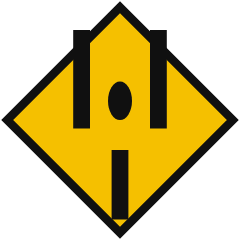
Show answer
Answer D: Driving on the far side of the separation, against the flow
Once the two directions are separated, each roadway carries one-way traffic, so crossing to the other side means driving into oncoming vehicles.
-
15. The traffic around you is moving well above the limit on a wide highway. What should you do?
Show answer
Answer D: Keep to the limit and stay to the right, letting faster traffic pass
The limit is a legal maximum, and the safe way to differ from the traffic around you is to keep right and let it go by.
-
16. You and an oncoming driver are both turning left at the same intersection. What is the usual rule?
Show answer
Answer D: Both turn in front of each other unless markings show otherwise
The normal practice is to pass driver side to driver side, turning in front of one another, unless pavement markings or signs direct a different path.
-
17. A center lane is marked with a broken yellow line on each side and is controlled by overhead lane signals. How is that lane used?
Show answer
Answer A: It carries traffic one way or the other according to the signals
A reversible lane is marked with broken yellow lines on both sides and its direction of travel is set by the lane control signals above it.
-
18. Which sign shape is reserved for one message only, the requirement to stop?
Show answer
Answer A: The octagon
The octagon is used for the stop sign and for no other message, so the outline alone identifies the requirement even when the legend is hard to read.
-
19. You park in your own driveway and the rear of the vehicle sticks out over the sidewalk. What is wrong with that?
Show answer
Answer C: It blocks the sidewalk and forces people into the street
A vehicle overhanging the sidewalk pushes pedestrians, wheelchair users and strollers into the roadway, and blocking a sidewalk is prohibited.
-
20. The green arrow protecting your turn changes to a steady yellow arrow. What is it telling you?
Show answer
Answer A: The protected turn is ending and you should prepare to stop
A steady yellow arrow warns that the arrow movement is being terminated and that a red indication will follow.
-
21. A sign showing a walking figure inside a red circle with a diagonal slash stands at the start of a bridge. What does it mean?
Show answer
Answer C: People on foot may not use that roadway
The no pedestrians sign excludes people on foot from that roadway altogether, which is common on high-speed bridges and freeways.
-
22. You are traveling in the same direction as a funeral procession and want to get ahead of it. What should you not do?
Show answer
Answer B: Driving in between the vehicles of the procession
Most states prohibit driving into or through a funeral procession, and cutting into the line leaves the drivers behind with no lead vehicle to follow, so go around only where passing is permitted.
-
23. You are turning left out of a driveway onto a busy two-way street. What must you do?
Show answer
Answer D: Wait for a gap in both directions before you start to move
The turn crosses one direction of traffic and joins the other, so you need a gap in both before leaving the driveway rather than stopping across a lane.
-
24. What does the traffic law actually say about the right of way?
Show answer
Answer B: It says who must yield; no driver is ever entitled to take the right of way
The law describes who must yield. Right of way is something you give; insisting on it when another driver does not yield causes crashes.
-
25. Below a speed limit sign is a smaller panel with white numbers on a black background and the word NIGHT. What does it show?
Show answer
Answer D: The limit that applies after dark
A night speed limit panel sets a separate legal maximum for the hours of darkness, and its reversed colors mark it as the night figure.