
Massachusetts RMV Permit Practice Test 28
- Questions25
- Correct to pass18
- Passing score72%
- Minimum age16 years
-
1. You are about to make a three-point turn on a narrow two-way street. What is the first step?
Show answer
Answer B: Pull close to the right edge, signal left and check traffic both ways
A three-point turn starts from a stop at the right edge with a left signal, and you only move once you have checked that both directions are clear.
-
2. How can you keep space at the sides of your vehicle in heavy traffic?
Show answer
Answer D: Drive in the gaps between the other vehicles rather than beside them
Travelling in the open spaces rather than alongside others keeps a way out open on at least one side.
-
3. There is a stop sign but no stop line and no crosswalk. Where must you stop?
Show answer
Answer A: Before entering the intersection, where you can see cross traffic
With no line or crosswalk, stop before you enter the intersection at the point where you can see traffic on the cross street.
-
4. The light ahead is green but traffic beyond the intersection is backed up. What should you do?
Show answer
Answer B: Wait behind the intersection until there is room to clear it completely
You may not enter an intersection unless you can get completely through it, because stopping inside blocks cross traffic when the signal changes.
-
5. A raised area crosses the roadway and carries a series of white markings on its face. What are those markings for?
Show answer
Answer A: To make the hump visible so drivers slow for it
Speed hump markings warn drivers that the pavement rises, which matters most at night or when the hump is in shadow.
-
6. A person with a guide dog is standing at the corner facing the street you are about to cross. What should you do?
Show answer
Answer D: Stop well back and wait quietly for them to decide
Blind pedestrians rely on engine sound to judge traffic, so stop back from the crossing and avoid the horn, which only confuses them.
-
7. Who does Massachusetts Personal Injury Protection cover after a crash?
Show answer
Answer A: The driver, household members, passengers and pedestrians
Massachusetts is a no-fault state, so Personal Injury Protection pays regardless of who caused the crash and reaches well beyond the policyholder.
-
8. What happens to a Massachusetts Junior Operator License after a first speeding conviction?
Show answer
Answer A: A 90 day suspension
A first speeding conviction suspends a Junior Operator License for 90 days, and any later speeding conviction brings a one year suspension.
-
9. At highway speed, a large object suddenly appears in your lane and there is open space beside you. Which response is often the most effective?
Show answer
Answer B: Steer around it, since at speed you can often turn quicker than you can stop
Above roughly 25 mph, stopping distance is long while a lane change takes only a moment. When space is available, a controlled steer around the hazard avoids the impact.
-
10. You are driving slower than the general flow on a multilane highway. Which lane should you use?
Show answer
Answer D: The right lane, keeping the left lanes free for faster traffic and passing
Slower traffic must keep right so that faster vehicles and overtaking traffic can use the left lanes without weaving between lanes.
-
11. You arrive at an intersection where the traffic signal is completely dark because of a power failure. How should you proceed?
Show answer
Answer C: Treat the intersection as an all-way stop
When a signal shows no indication at all, drivers on every approach must stop and then take turns, exactly as at an all-way stop.
-
12. What does compulsory Bodily Injury to Others coverage in Massachusetts not pay for?
Show answer
Answer D: Injuries to a passenger riding in your own car
Compulsory Bodily Injury to Others only covers crashes that happen in Massachusetts and never covers a passenger in the insured's own vehicle.
-
13. What is the Massachusetts road test fee, charged even when an applicant fails the test or fails to appear?
Show answer
Answer D: 35 dollars
The RMV charges a flat 35 dollar road test fee covering application processing and scheduling, and it must be paid again before a new test is booked.
-
14. On a rural road, the driver of a slow farm tractor ahead of you signals a left turn even though there is no road or driveway in sight. What should you do?
Show answer
Answer B: Stay behind the tractor, because it may be turning into a field entrance
Farm equipment often turns into fields through gaps you cannot see, and it may swing wide to do so. Passing a vehicle that is signaling a left turn is a common cause of crashes.
-
15. Freeway traffic ahead of you has come to a stop. Besides braking early, how can you warn the drivers behind you?
Show answer
Answer B: By switching on the hazard lights for a few seconds
A short burst of hazard lights is a recognized way to tell following traffic that the queue ahead has stopped, and it carries much further back than brake lights. Some states restrict hazard lights on a moving vehicle, so use them only for the moment you are slowing.
-
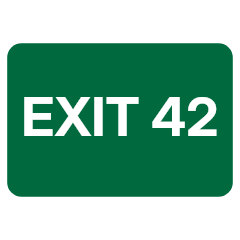
16. A driver in the left lane of a freeway realizes only when level with this sign that the ramp beside it is the one they need. What is the correct action?
Show answer
Answer A: Carry on to the next interchange and turn back from there
There is no safe way back to a ramp once it has been reached from the wrong lane, so the driver keeps going to the next interchange, where the ramps are built for that movement.
-
17. A white regulatory sign shows the silhouette of a truck inside a red circle with a diagonal slash. What does it mean?
Show answer
Answer A: Trucks are not allowed to use that road
The circle and slash over a symbol always means the movement or vehicle shown is prohibited, so trucks must keep off that roadway.
-
18. A wasp flies in through the open window while you are driving. What is the safest reaction?
Show answer
Answer B: Stay calm, slow down and stop somewhere safe
Far more crashes come from the driver's reaction to an insect than from the insect, so keep your eyes forward, slow down and deal with it stopped.
-
19. When counting prior offenses for a Massachusetts chemical test refusal suspension, what counts as a prior operating under the influence offense?
Show answer
Answer C: A conviction or an assignment to alcohol education
A prior offense means a court conviction or a court ordered assignment to an alcohol education program, and earlier chemical test refusals do not count.
-
20. How many compulsory coverages must every Massachusetts auto insurance policy include?
Show answer
Answer C: Four
Massachusetts requires four compulsory coverages: Bodily Injury to Others, Personal Injury Protection, Bodily Injury Caused by an Uninsured Auto, and Damage to Someone Else's Property.
-
21. Which of the four blind spots around a tractor-trailer is the largest?
Show answer
Answer A: The one on the right side of the truck
A truck has no-zones on all four sides, and the right-side blind spot is the largest because it runs back along the trailer and reaches across more than one lane.
-
22. Where is a strong crosswind most likely to hit you suddenly?
Show answer
Answer D: Coming out of a tunnel or a cut onto an open bridge
Gusts arrive the moment you leave shelter, which is why bridge approaches and the ends of cuts and tunnels catch drivers out.
-
23. What does a marked crosswalk tell a driver approaching a corner?
Show answer
Answer D: Where pedestrians are expected to cross and must be given way
Crosswalk markings show pedestrians where to cross and warn drivers to yield to anyone using the crossing.
-
24. You are passing a large truck on an open highway in a strong crosswind. What should you expect?
Show answer
Answer A: A push toward the truck, then a push the other way as you clear it
The truck shelters you as you go by and then releases you into the full gust, so the load on the steering changes twice during the pass.
-
25. You stop behind another vehicle at a traffic light. How much space should you leave?
Show answer
Answer D: Enough to see where its rear tires touch the pavement
Seeing the rear tires on the road leaves room to steer around the vehicle if it stalls, and gives a cushion if you are struck from behind.